I’m constantly being asked about generator power. With prices ranging from around $150 for a cheap 1000Watts generator to $4000 or more for really powerful 12000Watts generators, you really need to consider wisely how you’re spending your money.
Many folks want a small, fuel-efficient generator that’s easy to carry and doesn’t cost too much to buy or run. So a 1000Watts generator is wonderfully practical and economical but it has its limitations. A thousand watts isn’t that much power, so you need to see if it’s going to give you what you need.
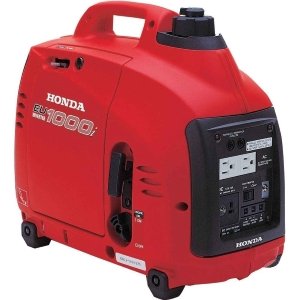 Firstly, we need to look at starting watts, an area of confusion for many. You’ll notice that most generator specs have ratings for running watts and starting or peak watts. Your peak wattage is always quite a bit higher than your running watts (usually around 20% more power). Peak watts is the power output that a generator can provide for a very short period of time – usually no more than about 5 seconds. Whereas running watts is the power that a generator can supply continuously.
The reason why a generator can provide peak watts is to allow for equipment that needs more power when starting. This is usually an inductive electric motor that uses a capacitor to start. Induction motors are used in all types of appliances from electric drills to refrigerators. The capacitor is used to counteract the force of inertia, giving it the power to go from a stationary position to a spinning motion. Compressors, like those used in refrigerators, air conditioners and air compressors need the highest starting watts because they have to start under load, that being the pressure inside the compressor tank. Electric motors used to run compressors can require up to three times their normal running power to start. Whereas an electric drill will only need 50% or less.
Other appliances that require a higher starting wattage are those that use a ballast. A ballast provides the extra current needed to cause an electric reaction across a non-conductive material – usually a gas or the air. These are commonly used in lights that don’t have a filament, like fluorescent lights. Microwave ovens also use a ballast. Ballasts require 50% to double the normal running wattage.
This basically means that you need to take into account the appliances that use a capacitor or ballast to start. These are going to need a lot more power for short period of time. This can be less than a second for most capacitors, while a lot of ballasts may take a few seconds to start. Your generator has to be able to handle this peak load. When you’re using a 1000 Watts generator, there aren’t many inductive motors that will start with this kind of power.
If you look at a standard refrigerator that you use in your home, it’s likely to run at about 1200 Watts, so you won’t be able to supply the running watts with a 1000 Watts generator, let alone the starting watts. Energy star rated refrigerators can be anything from 250 Watts up to 750 Watts, depending on their size and energy efficiency rating. This means that a 250 Watts refrigerator with a starting wattage of around 650 Watts-750 Watts will run off a 1000 Watts generator. Though you won’t have much power for anything else. Refrigerators with such a low energy rating
aren’t too common, so you’d need to shop around if you want one.
Generally, I don’t recommend refrigerators and microwaves for such a small generator. Not only will most of them require too much power, even most low wattage refrigerators, and microwaves will push the generator close to its limits. If you’re using a 1000 Watts generator for camping trips, I always recommend using a 12V DC refrigerator with a deep cycle battery. You can charge the battery with no problem using a 1000 Watts generator and you have the benefit of keeping your refrigerator running even when the generator is switched off. You can forget about running an AC unit of your 1000 Watts generator.
As for all your other appliances, we need to look at your needs. Are you using the generator for recreational use like camping or on a yacht? Or are you using it for work, like on a construction site? If you’re using your generator for backup power at home, your circumstances will be quite similar to recreational use, so we’ll be covering that under the same topic.
Using a 1000 Watts generator for recreational use
Here’s a list of the typical household appliances that will be able to run off a 1000 Watts generator and their estimated wattage. This is a general estimation and it’s always best to check the watt or amp rating on the appliance. To convert amps to watts, you just need to multiply the amps by the voltage. A 5A appliance at 120V will be as follows: 5 X 120 = 600 Watts.
- 42” Plasma TV 200W
- Satellite receiver or cable box 25W
- Surround sound system 150W, though some can be as high a 300W or more
- CFL lights 10W-30W
- LED lights 3W-15W
- Standard desktop computer with LCD monitor 300W
- Laptop 100W
- USB charger for smartphones and tablets 6W-8W
- Box fan 200W
- Small halogen space heater 400W-800W
Remember that electronic equipment like TVs and computers are easily damaged by harmonic distortion (HD). Harmonic distortion is usually at it it’s worst when a generator is working at 75% or more of its maximum running load capacity. Even a generator with a good automatic voltage regulator (AVR) won’t protect sensitive electronics at high load. It’s always best to use an inverter generator, especially if you’re using a smaller generator that doesn’t have a very high output. If you’re watching TV on a 1000 Watts generator that doesn’t have an inverter, it’s better to run very little else – try to keep your total load at less than 500 Watts. A TV has a starting wattage of about 30-50% of its normal running watts as do CFL lights.
Using a 1000 Watts generator on a worksite
There aren’t many power tools that you can use with a generator this small. You certainly won’t be running an air compressor or table saw. Though a few drills or other small power tools are fine. Here’s a list of typical hand tools that can run on a 1000 Watts generator. Again, these are estimated wattages and it’s always best to check the actual power tool for its exact power rating.
- ¼” drill 250W
- 1/2” drill 750W
- Battery charger for cordless tools 8W-15W
- Portable nail gun with built-in compressor 450W-650W
Remember that just about all power tools use an inductive motor with a capacitor. This means that you have to account for about 50% increase in your generator load every time these tools start. This is particularly important when you’re using a few tools at the same time. It’s likely that you’ll be starting and stopping a hand drill many times as you work. If you start several drills simultaneously, this could push up your peak watts by quite a bit.


Leave a Reply