A leaf blower is a very basic garden tool and deciding which one is best for you isn’t too difficult. There’s not too much to worry about in terms of safety and essentially, you want to get the best performance for the job at hand. When you look at leaf blower specs, it might not be very clear as to how you should interpret this information. This article will break it all down for you. With this information, you’ll be able to shop around and find the perfect leaf blower for your needs.
There are two basic specs that are important when it comes to how you intend to use the leaf blower - air volume and airspeed. Let’s start with these.
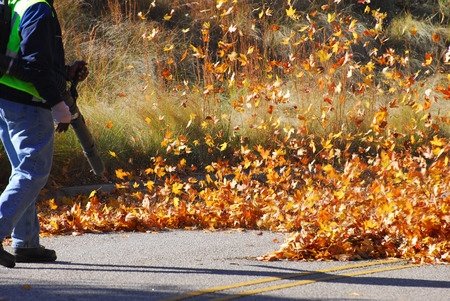
Air Volume
The volume of air that a leaf blower displaces is expressed in cubic feet per minute (CFM). So, what is CFM and why is it important to know about this? Every leaf blower has a turbine designed to move air, focusing on its speed and volume. The ratio between these two performance aspects will determine what purpose it can fulfill.
The CFM capability of a leaf blower is the amount of debris it is able to move at any given time. A machine with a high CFM spec will move a large volume of debris.
Airspeed
The speed of the air from the turbine is measured in Miles Per Hour (MPH). The airspeed of a leaf blower will affect it in two ways. A high airspeed will move debris over a larger distance - it will blow the leaves further with every blast. This means that you can cover a larger area with greater speed.
The second characteristic of airspeed is its ability to move a greater mass and dislodge compacted debris. A leaf blower with a high airspeed will be better suited for moving wet leaves, snow and heavier twigs or even small stones. It is also better at moving debris that has been compacted, like sticky leaves that have been compressed onto the driveway.
How airspeed and volume affect the way you use a leaf blower
To get an idea of how to interpret this information, think of how you would use a motor vehicle. If you want to move a large volume of goods, you want a pickup. Although a pickup isn’t too fast, you can move a lot more - you just won’t cover a large area in short space of time. If you want to move a few goods but want to get there faster, you’ll use a car that travels at a good speed.
If we use this example in the context of leaf blowers, the pickup will be one with a lower airspeed and a higher CFM. The car will be the opposite - high speed, low CFM. So, in your garden or around your home you face different situations. If you have a large lawn but it has few trees with only scattered leaves, a leaf blower with a higher speed and lower CFM will be better. You’ll be able to move across the lawn faster (blowing the debris over a greater distance) and you don’t need to move a large volume of debris. A large area with a lot of debris will require both speed and volume. If you want to clean a small concentrated area, like a patio that has a lot of leaves, CFM will be more important than speed.
Sometimes airspeed can be a disadvantage. If we use the vehicle analogy again, driving in a built up area at high speed is dangerous. On the open road, a higher speed is preferable because it will get you to your destination faster. If you’re using a leaf blower indoors or close to the exterior walls of your home, high speed can be dangerous. Blowing at high speed will flick up small stones or other heavier objects that can ricochet off a wall and harm people. These objects can also be flung at windows, causing them crack or break. So, obviously, in this situation, you would prefer a leaf blower with a lower speed.
Many people will be using their leaf blower in some or all of these situations. In this case, you want control over the machine’s speed. Some leaf blowers (usually low power models) have only one speed. Some have two speeds and then there are those that have infinite power control - meaning that you can increase or decrease the power as you work and use it any speed. Choosing the power control options of the leaf blower that you’ll be using depends on your yard and how you want to work.
Other Factors
Having covered the most important technical aspects, let’s take a look at what else you should consider. Using a gas leaf blower will give you the greatest amount of power and they are the best for large areas. However, gas leaf blowers are heavy and noisy. Weight and noise levels should also be taken into consideration. Using a heavy machine for extended periods of time is not for everyone. You get very light electric leaf blowers that can be easily handled by anyone. If you live in a neighborhood where noise needs to be considered, going electric is preferable and there are some models that are designed to be exceptionally quiet.


Leave a Reply